A Schengen airport transit visa (ATV) lets certain nationalities change planes in the international area of a Schengen airport without entering Schengen. Citizens of 12 countries on the EU-wide list (including Pakistan, Bangladesh, Nigeria, Ghana and Sri Lanka) need one, and individual countries such as Germany or France add more nationalities. Holding a valid US, Canadian, Japanese or EU visa usually exempts you.
Every year, travellers are refused boarding at check-in because they didn’t know they needed a visa just to change planes in Frankfurt, Paris or Amsterdam. That visa is the Schengen airport transit visa (ATV), and it applies even if you never leave the airport.
This guide explains who needs one, who’s exempt, and how to avoid the problem altogether.
What is a Schengen airport transit visa?
An airport transit visa (ATV), also called a “type A” visa, allows you to pass through the international transit area of an airport in a Schengen country while changing flights. It does not let you enter the Schengen area, even for an hour.
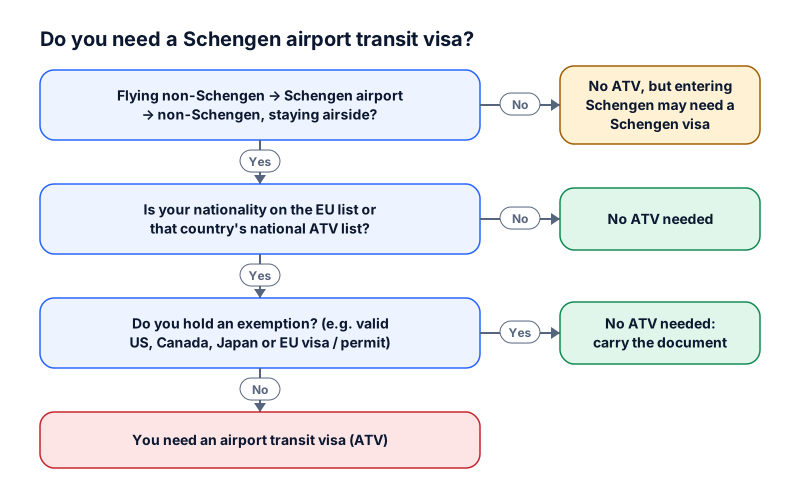
You only need it when both of these are true:
- You’re flying from a non-Schengen country to another non-Schengen country (for example, Lagos → Frankfurt → Toronto), and
- Your nationality is on the EU-wide ATV list or on that specific country’s national list.
If your trip touches two Schengen airports (for example Delhi → Paris → Rome), you’re entering Schengen at your first stop. That needs a regular Schengen visa, not an ATV.
Which nationalities need an ATV in every Schengen country?
Under the EU Visa Code, citizens of these countries need an airport transit visa at all Schengen airports (unless exempt):
| Country | Country | |
|---|---|---|
| Afghanistan | Iraq | |
| Bangladesh | Nigeria | |
| DR Congo | Pakistan | |
| Eritrea | Somalia | |
| Ethiopia | Sri Lanka | |
| Ghana | Iran |
On top of this list, individual Schengen countries can require ATVs from additional nationalities. Germany, France, the Netherlands, Spain and others maintain their own national lists, which change more often than the EU-wide list. That’s why the same passport can need an ATV in Frankfurt but not in Zurich, or vice versa.
👉 Check your exact passport and country on our transit visa checker.
Who is exempt from the airport transit visa?
Even if your nationality is on a list, you’re usually exempt if you hold one of these:
- A valid visa or residence permit for an EU/EEA country or Switzerland
- A valid visa for the United States, Canada or Japan (conditions can apply)
- A valid residence permit for the US, Canada, Japan, Andorra or San Marino
- Proof you’re a family member of an EU citizen
- A diplomatic passport, or you’re an airline crew member
Bring the physical document with you. Exemptions only work if the airline can see the visa or permit at check-in.
How to apply for an airport transit visa
- Find the right consulate. Apply to the country where you’ll change planes. If you change planes in two Schengen airports, apply to the one where you spend the longest.
- Prepare documents. Typically: application form, passport valid for at least 3 months beyond your trip, photos, confirmed onward ticket, a visa for your final destination (if needed) and travel insurance where required.
- Pay the fee. ATVs cost the standard Schengen visa fee (€90 for adults since 2024).
- Apply early. Decisions usually take up to 15 days. Apply 3–4 weeks before travel.
How to avoid needing an ATV
If you don’t qualify for an exemption, the easiest fix is often to route through a hub that doesn’t require one:
- Gulf hubs such as Dubai and Doha let most passengers connect airside without a visa.
- Istanbul usually allows airside transit without a Turkish visa.
- Direct flights, even if slightly more expensive, remove the problem entirely.
A cheaper ticket through Europe isn’t a bargain if you’re refused boarding or have to pay for a visa and documents.
Common mistakes
- “I’m not leaving the airport, so I don’t need a visa.” For ATV nationalities, that’s exactly when you need one.
- Separate tickets. If your bags aren’t checked through, you’ll have to enter Schengen to re-check them, and an ATV won’t allow that.
- Expired exemption visas. A US visa that expired last month doesn’t count.
- Forgetting the return trip. Your return may route through a different country with a different national list.
Rules change. Always confirm with the embassy of the transit country or your airline before you travel. See our step-by-step checking method.
Frequently asked questions
Do I need an airport transit visa if I have a US visa?
Usually not. Holders of a valid visa for the United States, Canada or Japan, or of a valid visa or residence permit from an EU/EEA country, are generally exempt from the airport transit visa requirement. Check the exact conditions with the country you are transiting.
Can I leave the airport with an airport transit visa?
No. An airport transit visa only allows you to stay in the international transit area. To leave the airport you need a Schengen short-stay (type C) visa or a visa-free entitlement.
How long does an airport transit visa take?
Schengen consulates generally decide within 15 calendar days, but it can take longer in busy periods. Apply at least 3–4 weeks before you travel.
Do I need an ATV if my connection is from one Schengen country to another?
An ATV does not cover that. If you fly into one Schengen country and connect to another Schengen country, you enter the Schengen area at your first stop and need a regular Schengen visa (unless visa-exempt).