On a single ticket, aim for at least 60–90 minutes for international connections at large hubs, and 2–3 hours if you change terminals, pass immigration or customs, or travel in winter. On separate (self-transfer) tickets, allow at least 3–4 hours, because you must collect and re-check bags and nobody will rebook you if you miss the flight.
“Is 55 minutes enough?” is one of the most common questions travellers ask before booking. The honest answer: it depends on what happens between the two gates. Here’s how to judge any connection in a minute.
Want a personalised estimate? Try our layover time calculator.
What is a minimum connection time (MCT)?
Every airport publishes minimum connection times: the shortest legal gap between two flights for the connection to be sold on one ticket. They depend on:
- Route type: domestic → domestic, international → international, international → domestic
- Terminals: same terminal or a terminal change
- Airlines: some alliance partners have shorter, coordinated MCTs
Typical MCTs range from 30–45 minutes for simple domestic connections to 60–90+ minutes for international connections involving terminal changes or immigration.
The MCT is a minimum, not a recommendation. It assumes things mostly go to plan.
Realistic layover lengths
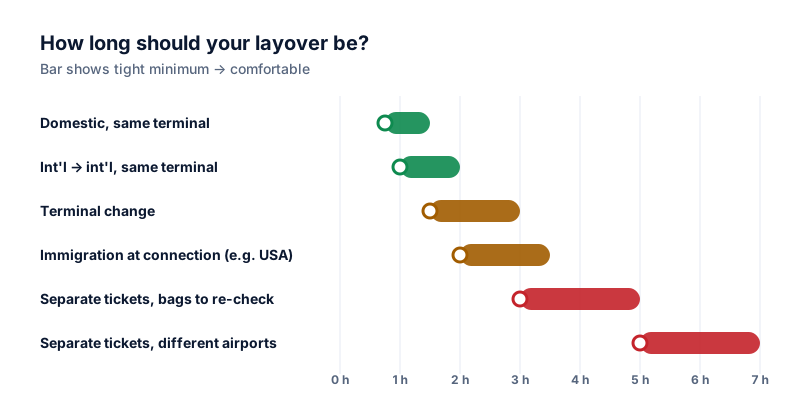
| Connection type | Tight but possible | Comfortable |
|---|---|---|
| Domestic → domestic, same terminal | 45 min | 1–1.5 h |
| International → international, same terminal (airside) | 60 min | 1.5–2 h |
| Terminal change (e.g. Heathrow T3 → T5) | 90 min | 2–3 h |
| Through immigration/customs (e.g. arriving in the US) | 2 h | 3 h+ |
| Separate tickets, bags to re-check | 3 h | 4–5 h |
| Separate tickets, different airports | 5 h | Overnight |
7 factors that make a layover riskier
- Immigration on arrival. Countries like the US and Canada require all passengers to clear immigration and customs at the first airport, even when connecting.
- Terminal changes. Shuttle buses, trains and second security checks add 20–45 minutes.
- Separate tickets. You’ll need to land, collect bags, exit, check in again and pass security, and the second airline owes you nothing if you miss it.
- Delay-prone first flight. Check the on-time history of your inbound flight.
- Season and time of day. Winter weather, summer thunderstorms and evening banks of departures all add risk.
- Huge airports. At Istanbul or Dubai, the walk alone can take 20+ minutes.
- Transit visa checks. Document checks at transfer desks can create queues.
What happens if I miss the connection?
On one ticket, the airline must get you to your destination, usually on the next available flight, and may owe you meals, a hotel or compensation. On separate tickets, you’re usually on your own. Read our full guide: What happens if you miss a connecting flight.
Tips for tight connections
- Sit near the front of the first flight and keep carry-on only if possible.
- Download the airline app to see gate changes instantly.
- Check the terminal map before landing.
- Tell the crew if you’re tight; they sometimes help with priority disembarkation or transfer assistance.
- Don’t stop for duty-free until you’ve found your departure gate.
Bottom line: on one ticket, trust the MCT but add a buffer if any risk factor applies. On separate tickets, give yourself hours, not minutes.
Frequently asked questions
Is a 1-hour layover enough?
Often yes, for a same-terminal connection on one ticket at an efficient airport. It is risky if you change terminals, pass immigration, have a checked bag on separate tickets, or your first flight is often delayed.
What is a minimum connection time (MCT)?
An MCT is the shortest connection time an airport and airline officially allow for a connection to be sold on one ticket. It varies by airport, terminal and route type (domestic or international).
Will the airline sell me a connection that is too short?
Airlines will not sell a single-ticket connection below the official MCT. But the MCT is a minimum, not a comfortable buffer, and booking sites can combine separate tickets with no MCT protection at all.
What is the longest layover allowed?
On international itineraries, a connection of up to 24 hours is usually treated as a transfer. Longer stops are often treated as a stopover, which can change fares and visa requirements.